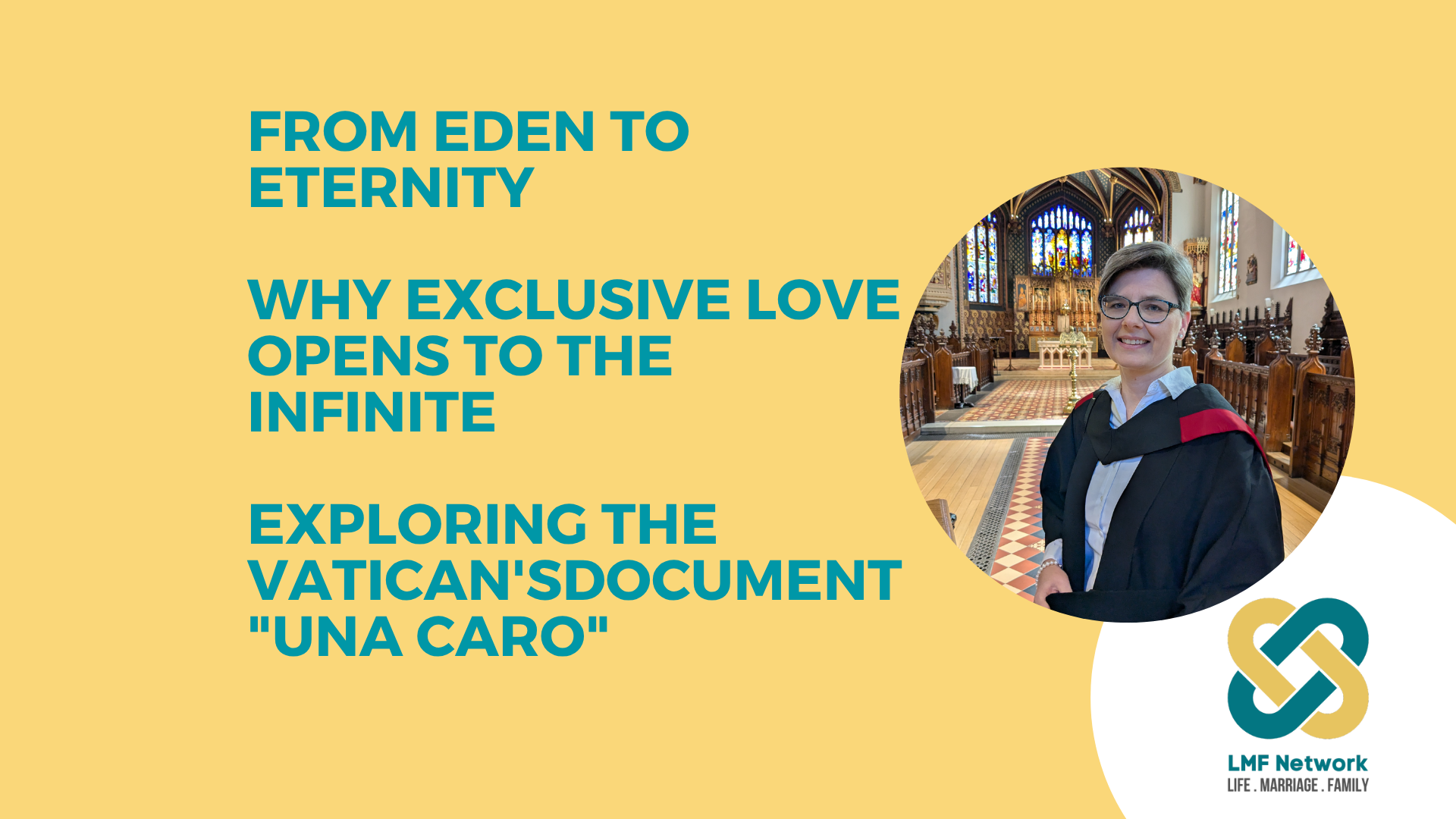
Why Exclusive Love Opens to the Infinite exploring the Vatican’s document Una Caro (One Flesh) a response to African polygamy and Western polyamory.
Meeting Summary
Dr Agata Mleczko presented on Una Caro (“One Flesh”), a document published in November 2025 by the Dicastery for the Doctrine of the Faith under Pope Leo XIV — the most significant Vatican document on the theology of marriage since Amoris Laetitia. Rather than a document of prohibition, Una Caro is framed as a positive proposal: a rich exploration drawing on scripture, the Church Fathers, medieval theology, phenomenology, and poetry to answer one central question — why does exclusive love open to the infinite? Dr Mleczko structured her presentation around three pillars: because of who God is, because of how we were created, and because of what exclusive love is and where it leads.
The first pillar was theological: God’s love for his people in scripture is always exclusive — the covenant formula “I will be your God and you will be my people” is a marriage formula. Christ reveals himself as the bridegroom, giving himself once, totally, to his Church. When exclusivity is removed from marriage, the sign no longer tells the truth.
The second pillar was anthropological: drawing on John Paul II, she argued that total self-gift is only possible between two people. The moment the gift is divided among many, it becomes distribution of portions — and persons cannot be loved in pieces. The third pillar was what she called the deepest answer: the infinite is not found by going wide but by going deep. A spouse made in the image of God is inexhaustible. After fifty years of faithful marriage, there is always more — not because the relationship is failing, but because you are touching something of divine depth in another person.
The discussion that followed ranged across the pastoral implications: how couples evangelise not through words but through hospitality and bodily presence; the challenge of accompanying those in irregular situations; and the complex pastoral question of polygamous converts to Catholicism in multicultural Australia.
Dr Mleczko closed with a reflection on a woman who remained faithful after her husband left her, praying she would die first so that he could regularise his situation in the Church — and the eschatological grounding required to hold that kind of fidelity.
About the Presenter
Dr Agata Mleczko is an interdisciplinary scholar with a background in migration studies, education, and the theology of marriage, currently serving as Programme Director for Further Education Courses at the Maryvale Institute in the United Kingdom. She and her husband have been involved in marriage ministry in Italy and Poland through the Sposati per Sempre (Marriage Forever) movement, and she has written on Una Caro for the Marriage Resource Centre. She lives in Poland with her husband.
Key Takeaways
- Una Caro is not a defensive document. It is a positive theological proposal — the Church is not saying “please keep traditional marriage,” it is saying “look at what this union reveals.” Exclusive love is not a restriction; it is the condition for love’s fullness, and it participates in the love of the One who is infinite.
- Monogamy and monotheism. The exclusive, faithful, total love of husband and wife speaks the truth of the God who is one — and when that exclusivity is removed, the revelation is lost. This is the deepest answer to “why only one person?” — not psychological, not pastoral, but theological.
- The infinite is found by going deep, not wide. A spouse made in the image of God is inexhaustible. After decades of shared life and prayer, there is always more — not because the relationship is incomplete, but because you are touching divine depth in another person. Polyamory mistakes the infinite for a supply of new things; the Church says the infinite is a quality, not a quantity.
- Marriage is the most misunderstood sacrament in the Church. Because it seems natural and obvious, we don’t go deep enough to ask the serious questions John Paul II asked — and when those questions come from the culture, we lose the argument because we haven’t done the theological work. Una Caro is an invitation to go deeper.
- Married couples evangelise through their bodies, not their words — through hospitality, shared meals, active listening, and simply being present in people’s lives over time. This is a distinct and irreplaceable form of mission that priests cannot offer in the same way, and it is one of the least used resources in the Church’s evangelising strategy.