
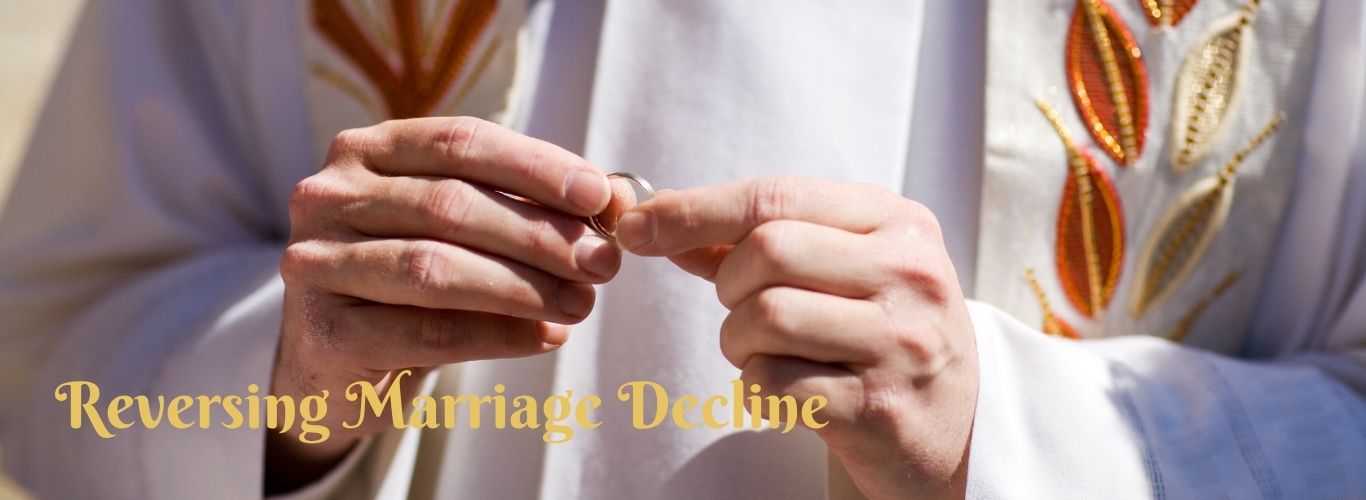
When the latest U.S. Census data crossed diocesan desks this year, it confirmed what many pastors and marriage ministers have long sensed in empty pews and declining nuptial Masses: Catholic marriage is in free fall.
October 6, 2026
Catholic weddings in the USA have declined nearly 60 percent since 2000, and roughly 75 percent since 1970 – a collapse from some 426,000 Catholic marriages a year to barely 85,000. Overall, married households now make up only 47 percent of American homes, down from two-thirds a generation ago.
Nor is this an American peculiarity.
- Australia’s marriage rate has fallen 23 percent since the mid-2000s, with 2025 bringing a further 1.7 percent drop in weddings registered.
- In England and Wales, the share of adults who are married or in a civil partnership slipped from 52.3 percent to 51.1 percent in just the past decade, as cohabitation continues to rise.
- >>And in New Zealand, the marriage rate has nearly halved since 2000, and sits at roughly a sixth of its 1971 peak.
Wherever the data comes from, the direction is the same: Marriage is on the decline and Catholic weddings have been in retreat for decades.
Responding, not Despairing
It would be easy to read these figures as simply one more casualty of secularization. But commentators responding to the data – among them Patrick T. Brown and Julia Dezelski of the USCCB – are reading them instead as a summons. Dezelski has called for “significant, incisive action,” both within the Church and in the wider culture.
Brown’s diagnosis is pointedly pastoral: young Catholics are not rejecting marriage so much as they are unformed for it. They need the Church to make marriage visibly attractive again, to create ordinary occasions – parish socials, young-adult groups, honest conversations about commitment – where pairing off and discerning vocation can actually happen.
For those of us in marriage formation, this is not a counsel of despair but a clear brief. The data names a mission field: the twenty- and thirty-somethings in our pews (and the many more who have drifted from them) who still, by most surveys, want lasting love but lack the confidence, the models, and the ordinary social scaffolding to pursue it.
Sacramental preparation programs, mentor-couple ministries, and parish-based accompaniment are no longer peripheral enrichment activities – they are front-line evangelization, which is precisely why the marriage formation community needs to be innovating with technology to enhance the reach and effectiveness of the programs on offer.
Programs such as SmartLoving Engaged, built for parish-based accompaniment with a mentor couple, show one practical way dioceses are already walking this ground. But we need more than courses for couples already partnered and preparing for marriage. We need opportunities that empower singles and engage with them while dating.
The Church has always taught that marriage is a vocation to be formed for, not simply entered into. If the pipeline of couples reaching the altar has narrowed this dramatically, our response cannot be to wait more patiently at the end of it. It must be to walk further upstream – into singleness, dating, and discernment – and to make the case, in word and in joyful witness, that sacramental marriage remains worth the risk of love.
The numbers are stark. Our calling has rarely been clearer.
Sources:
- U.S. Census Bureau, America’s Families and Living Arrangements (Dec. 2025), as reported by Catholic Review/OSV News, Feb. 9, 2026;
- Australian Bureau of Statistics, Marriages and Divorces, Australia (2025);
- UK Office for National Statistics, via Family Law (Aug. 3, 2026);
- Stats NZ, Marriages, Civil Unions and Divorces: Year Ended December 2025, as reported by 1News (May 4, 2026).






Leave A Comment
You must be logged in to post a comment.